The Canon · Folio One
Plate IV of XXIX
The Sun at the Centre
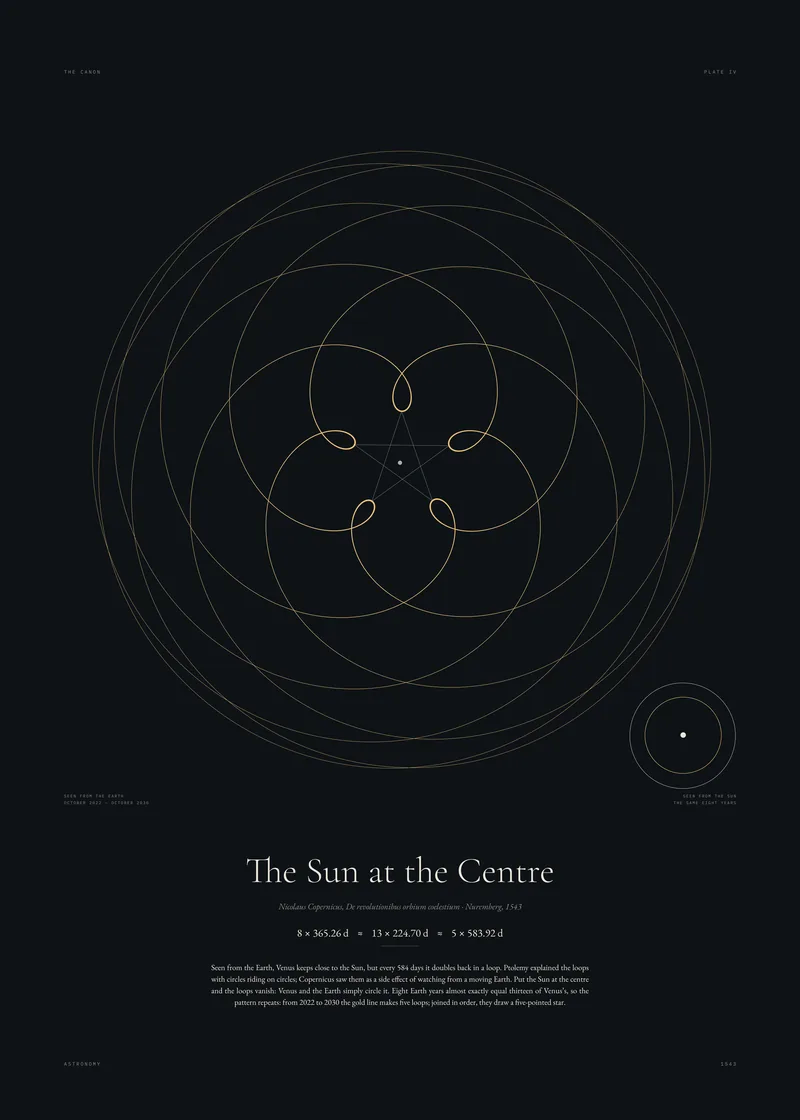
Seen from Earth, Venus draws a five-pointed star every eight years.
Night ground, a deep blue-black, on Canson Baryta Photographique, 310 gsm
The plate
Nicolaus Copernicus, De revolutionibus orbium coelestium · Nuremberg, 1543
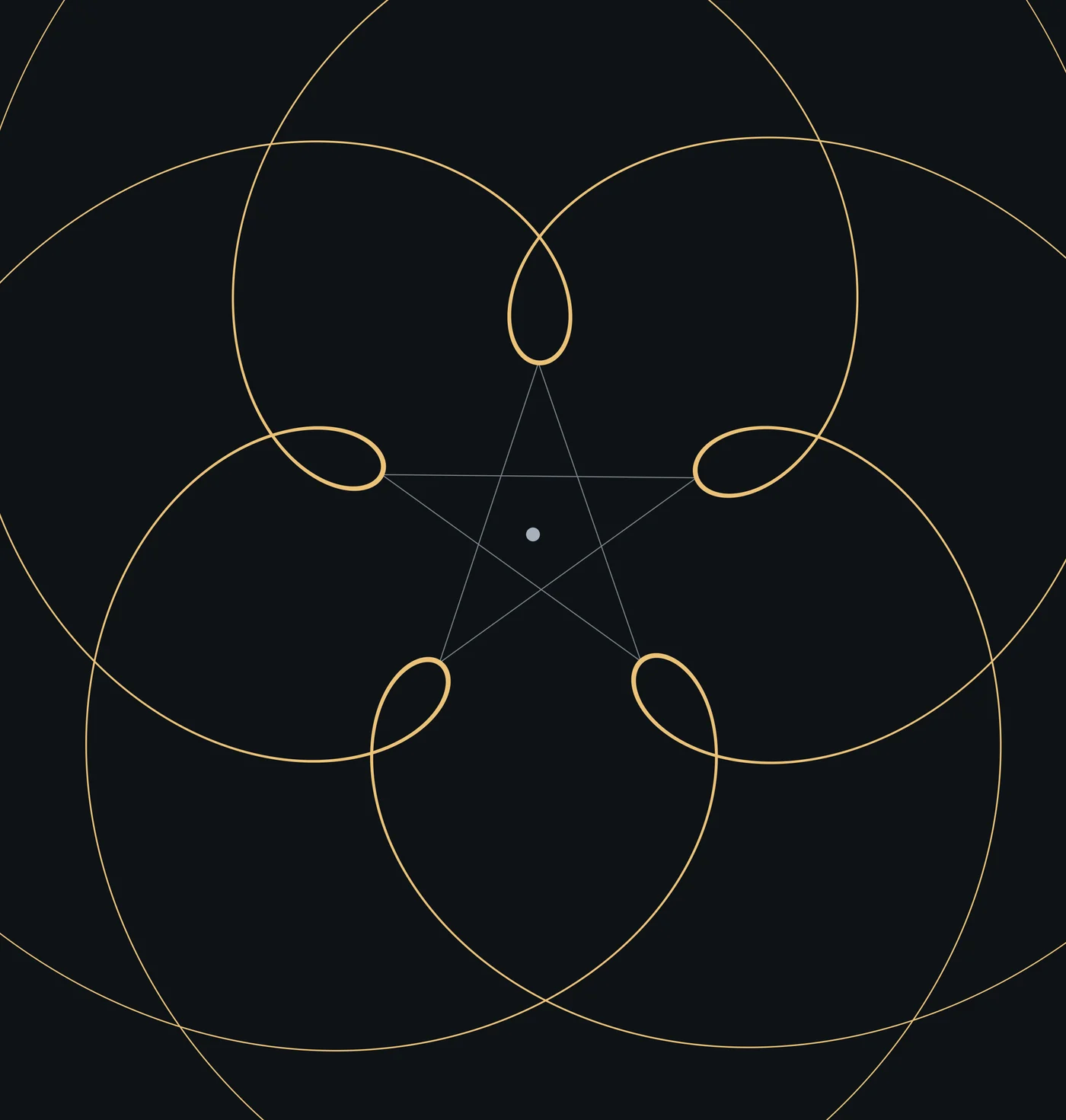
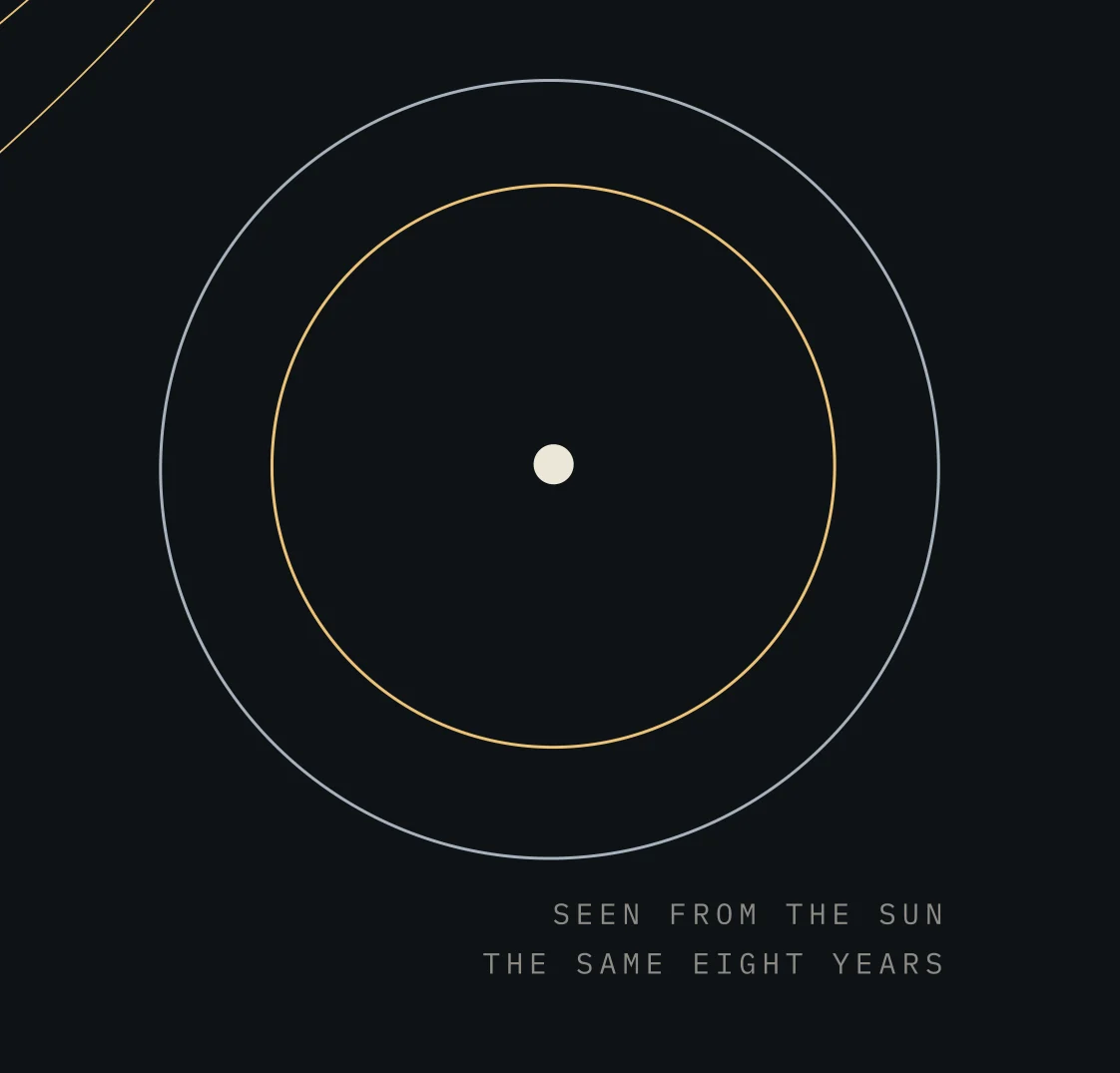
Seen from the Earth, Venus keeps close to the Sun, but every 584 days it doubles back in a loop. Ptolemy explained the loops with circles riding on circles; Copernicus saw them as a side effect of watching from a moving Earth. Put the Sun at the centre and the loops vanish: Venus and the Earth simply circle it. Eight Earth years almost exactly equal thirteen of Venus’s, so the pattern repeats: from 2022 to 2030 the gold line makes five loops; joined in order, they draw a five-pointed star.
Computed, not drawn: every mark on the plate comes from the mathematics or from real data, and the type is set from the same files that go to the printer.
Orbits from JPL’s Keplerian Elements for Approximate Positions of the Major Planets, courtesy NASA/JPL-Caltech.
Sizes and prices
| Size | Unframed | Framed | |
|---|---|---|---|
| Small30 × 42 cm | £50$85 | £140$185 | 297 × 416 mm |
| Medium50 × 70 cm | £110$165 | £350$465 | 500 × 700 mm |
| Large70 × 98 cm | £190$255 | £520$695 | 700 × 980 mm |
- Paper: Canson Baryta Photographique, 310 gsm, printed as a giclée by theprintspace.
- Printed in: London for the UK, Brooklyn for the US. Unframed prints travel rolled in a tube.
- Framed small: A3 (29.7 × 42 cm) frame, glazed with glass.
- Framed medium: 60 × 80 cm frame with a 5 cm window mount, glazed with 3 mm acrylic.
- Framed large: 70 × 100 cm frame, glazed with 3 mm acrylic.
- Frames: black, white or oak, solid wood, made in Germany. Each comes ready to hang.
- Edition: open, with a certificate. File version v1.