The Canon
Demonstration IV
The Lines of Fraunhofer
How many slits a grating needs to show sodium’s D line as two, worked out step by step.
A Demonstration is a plate’s companion print: the reasoning behind the discovery, worked out on a sheet of its own.
Paper ground, a warm cream, on Hahnemühle Photo Rag, 308 gsm cotton

The plate it accompanies
Plate IV, The Lines of Fraunhofer: Dark lines in sunlight tell us what the Sun is made of. See it
What it shows
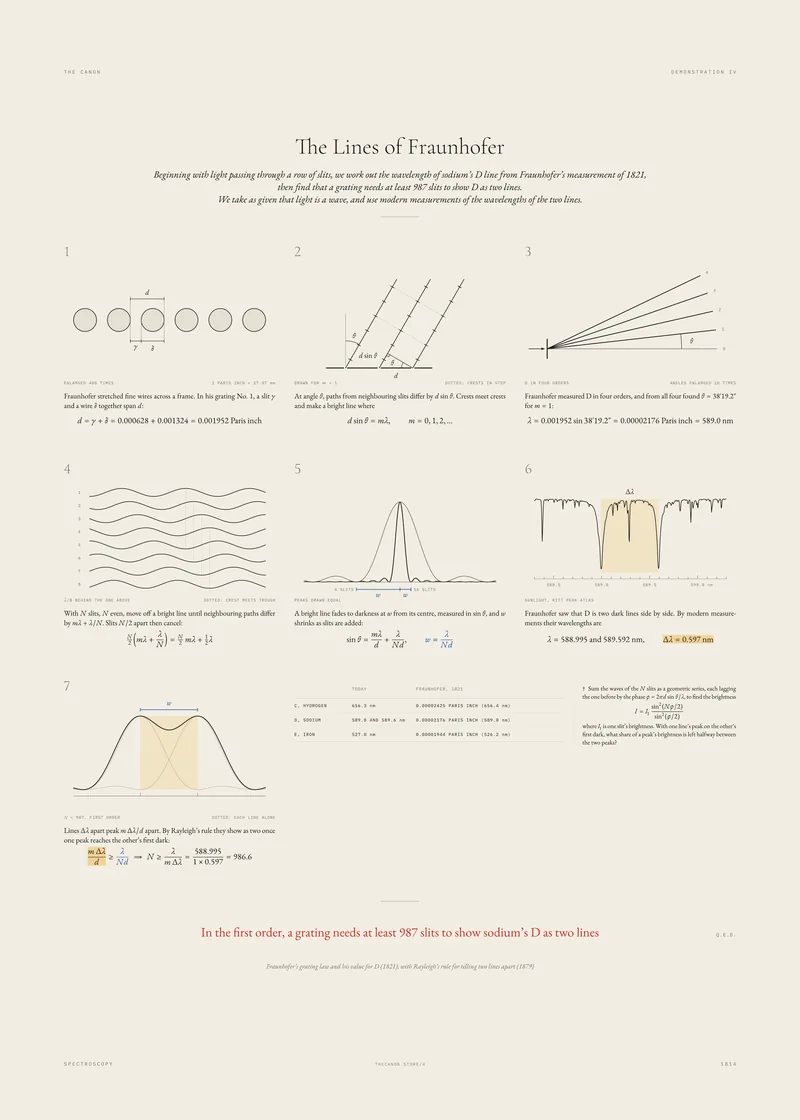
Plate IV shows sunlight spread into its colours and crossed by dark lines. Joseph von Fraunhofer mapped the lines in 1814, and in 1821 he measured their wavelengths with gratings he made by stretching fine wires across a frame. This sheet starts from his grating No. 1. From the spacing of its wires and the angle through which it bent the light of the D line, it works out the wavelength of D as Fraunhofer did, and finds 589.0 nanometres.
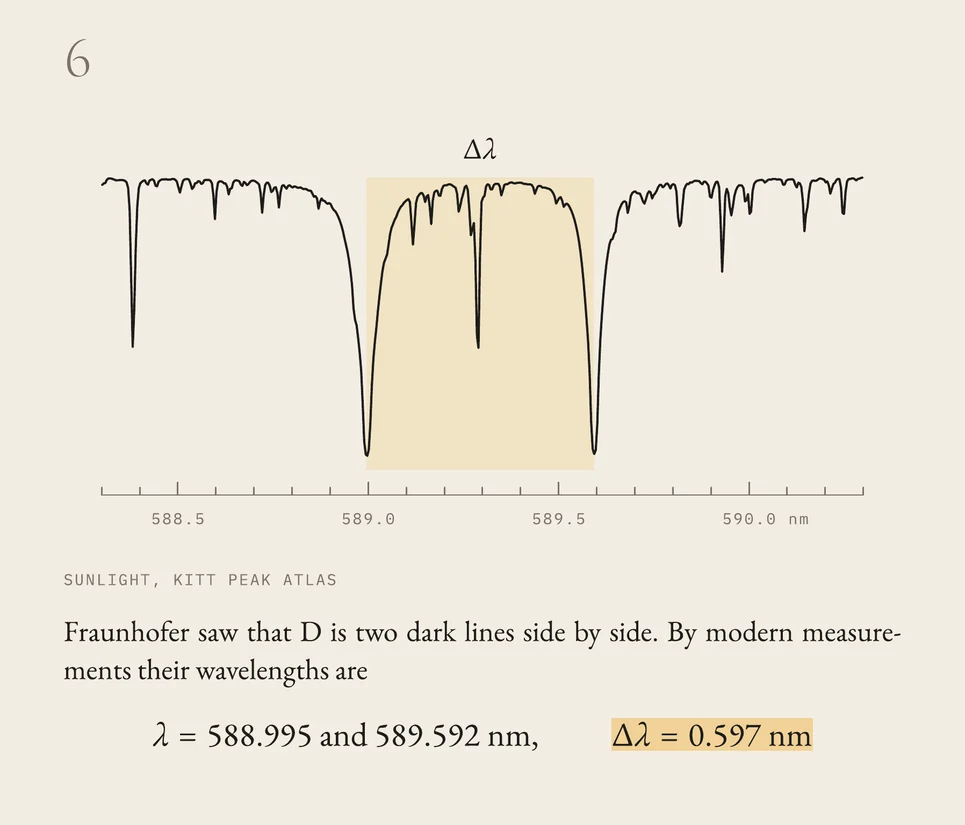
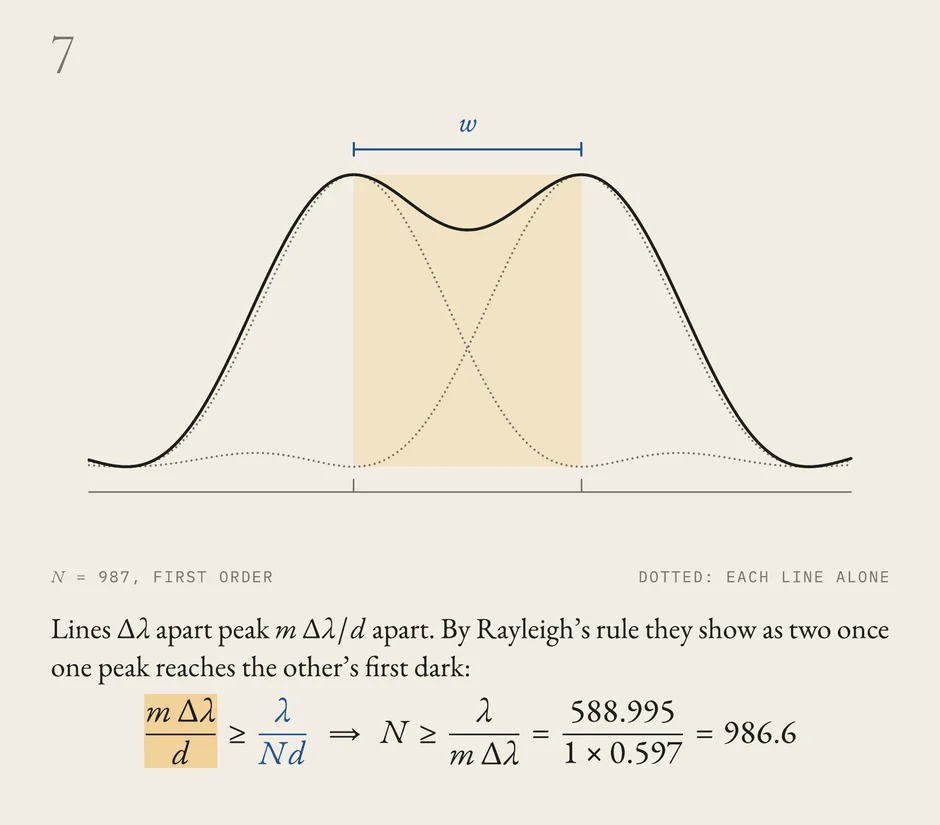
Fraunhofer also saw that D is two lines close together, which modern measurements put at 588.995 and 589.592 nanometres. Each bright line a grating makes grows narrower as slits are added, and the sheet works out how narrow the lines must be before the pair can be seen as two. By Rayleigh’s rule, a grating needs at least 987 slits to show sodium’s D as two lines in the first order.
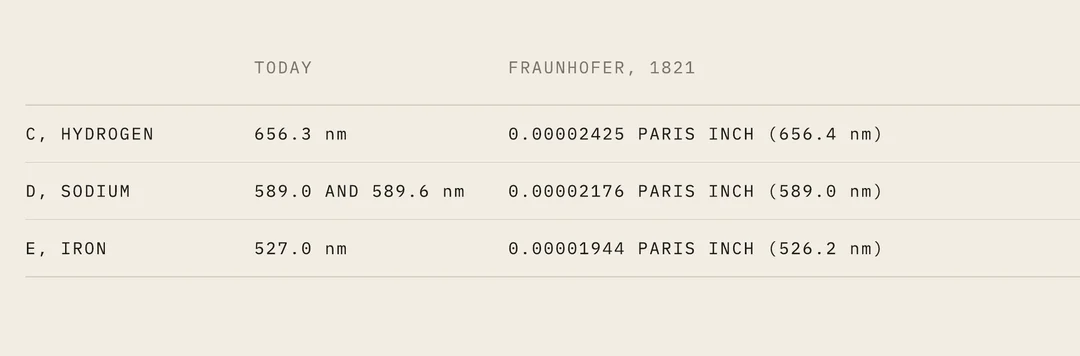
Fraunhofer’s 1821 values for three of his lines sit on the sheet beside today’s. He gave them, as he gave the widths of his wires, in fractions of a Paris inch. Converted, each comes within a nanometre of today’s value.
Close up, at about the size it prints at Medium
Hang them together
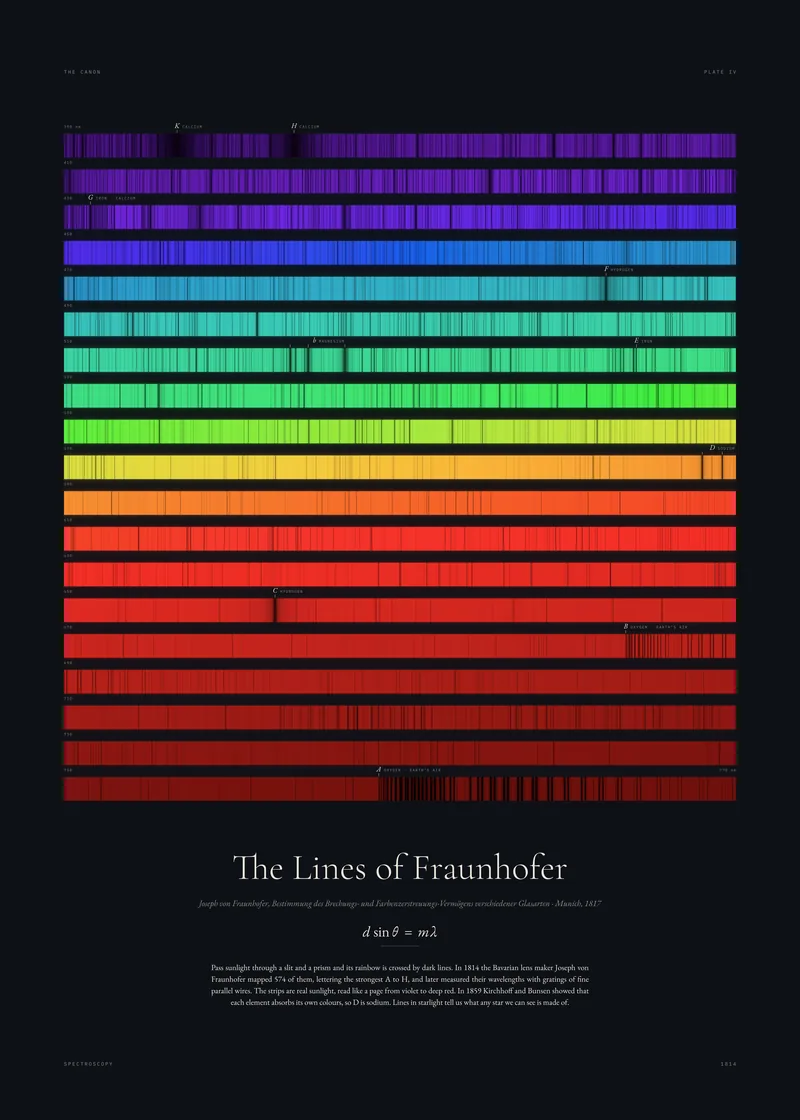
Demonstration IV is the companion to Plate IV, The Lines of Fraunhofer, which shows the dark lines in sunlight. Hung side by side in the same size and frame, the two cost 10% less bought together.
Plate IV and Demonstration IV, Medium, 42 × 59 cm each, in black frames.
The sheet
Fraunhofer’s grating measurements of 1821, with Rayleigh’s rule for telling two lines apart and modern measurements of sodium’s D
- 1Fraunhofer’s grating No. 1
- 2The path difference between neighbouring slits
- 3The wavelength of D, from his measurement
- 4Slits that cancel in pairs
- 5How narrow a bright line is
- 6The two lines of D in sunlight
- 7The slits needed to show D as two lines
- †And a question to take further: how much light is left halfway between the two peaks
Sizes and prices
| Size | Unframed | Framed | |
|---|---|---|---|
| Medium42 × 59 cm | £95$145 | £225$295 | 420 × 594 mm |
| Large59 × 84 cm | £160$215 | £390$515 | 594 × 841 mm |
| Extra large84 × 119 cm | £285$385 | Unframed only | 841 × 1189 mm |
- Paper: Hahnemühle Photo Rag, 308 gsm cotton, printed as a giclée by theprintspace.
- Printed in: London for the UK, Brooklyn for the US. Unframed prints travel rolled in a tube.
- Framed medium: A2 frame, glazed with 3 mm acrylic.
- Framed large: A1 frame, glazed with 3 mm acrylic.
- Extra large: unframed only. A0 is a standard frame size.
- Frames: solid wood, finished in black, white or oak veneer, made in Germany. Each comes ready to hang.
- Edition: open, with a certificate. File version v1.