The Canon
Plate IV
The Lines of Fraunhofer
Dark lines in sunlight tell us what the Sun is made of.
Night ground, a deep blue-black, on Canson Baryta, 310 gsm

Its companion print
Demonstration IV: How many slits a grating needs to show sodium’s D line as two, worked out step by step. See it
On the wall

Why it endures
Joseph von Fraunhofer was a glazier’s son, orphaned at eleven and apprenticed to a mirror maker in Munich, who kept him working without pay and forbade him to study. In 1801 the mirror maker’s house, where Fraunhofer lodged, collapsed and buried him for hours. The Elector of Bavaria watched him pulled out alive and gave him eighteen ducats, enough to buy a glass-grinding machine and his freedom from the apprenticeship. By 1814 he was running a glassworks near Munich, trying to make better telescope lenses.
Testing his glass, he looked at sunlight through a prism and a telescope and found its colours crossed by hundreds of dark lines. He mapped 574 and used them as fixed marks, and his lenses became the finest of their time. He saw that D sat exactly where a lamp flame shows a bright yellow line, and that the stars had lines of their own, but he died in 1826, aged 39, without learning what made them. His gravestone in Munich reads Approximavit sidera, “he brought the stars closer”.
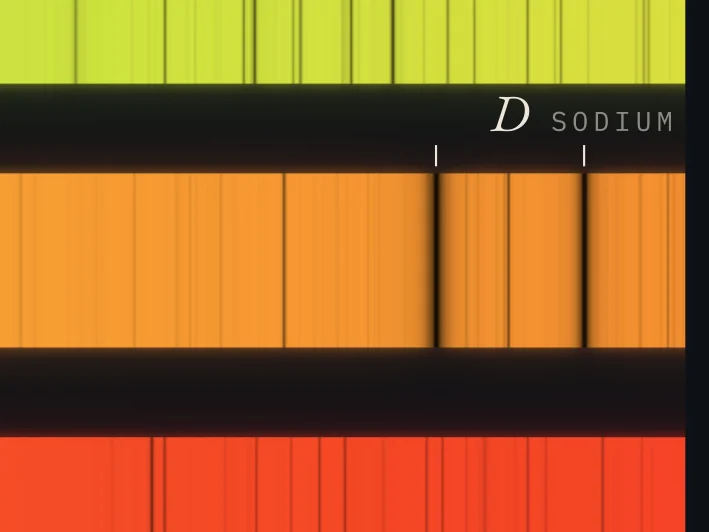
In 1835 the philosopher Auguste Comte wrote that we would never know what the stars are made of. Twenty-four years later, Gustav Kirchhoff and Robert Bunsen showed that each element absorbs its own colours, and that Fraunhofer’s D was sodium in the Sun. A yellow line in the Sun that matched no known element was named helium, after the Greek word for the Sun. In 1925 Cecilia Payne used the lines to show that stars are made mostly of hydrogen and helium. Astronomers now read what any star we can see is made of from the lines in its light.
Hang them together
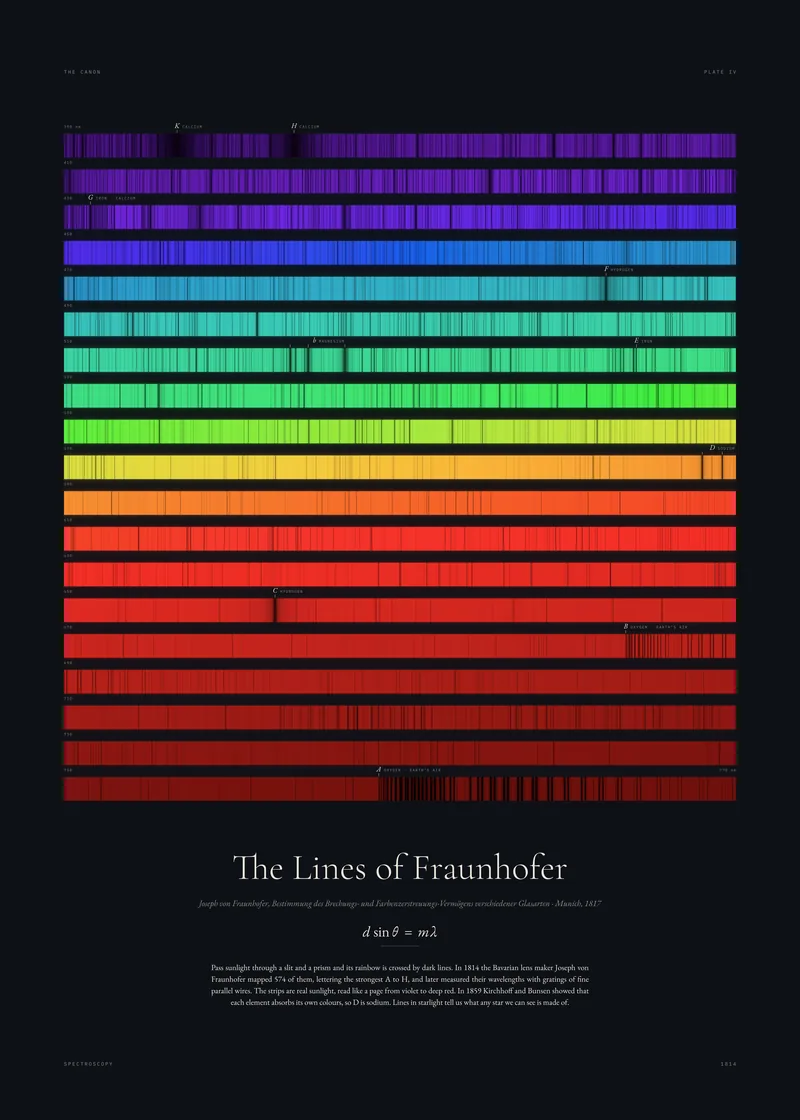
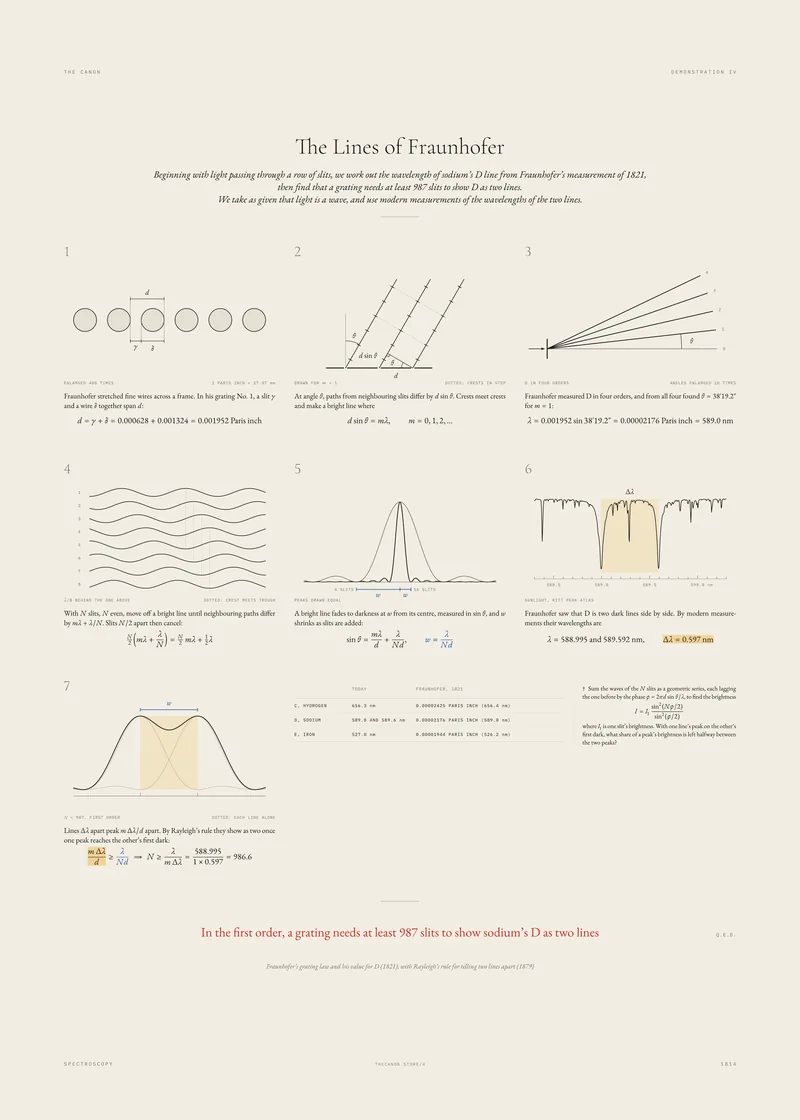
Plate IV has a companion print, Demonstration IV, which works out how many slits a grating needs to show sodium’s D line as two. Hung side by side in the same size and frame, the two cost 10% less bought together.
Plate IV and Demonstration IV, Medium, 42 × 59 cm each, in black frames.
The plate
Joseph von Fraunhofer, Bestimmung des Brechungs- und Farbenzerstreuungs-Vermögens verschiedener Glasarten · Munich, 1817
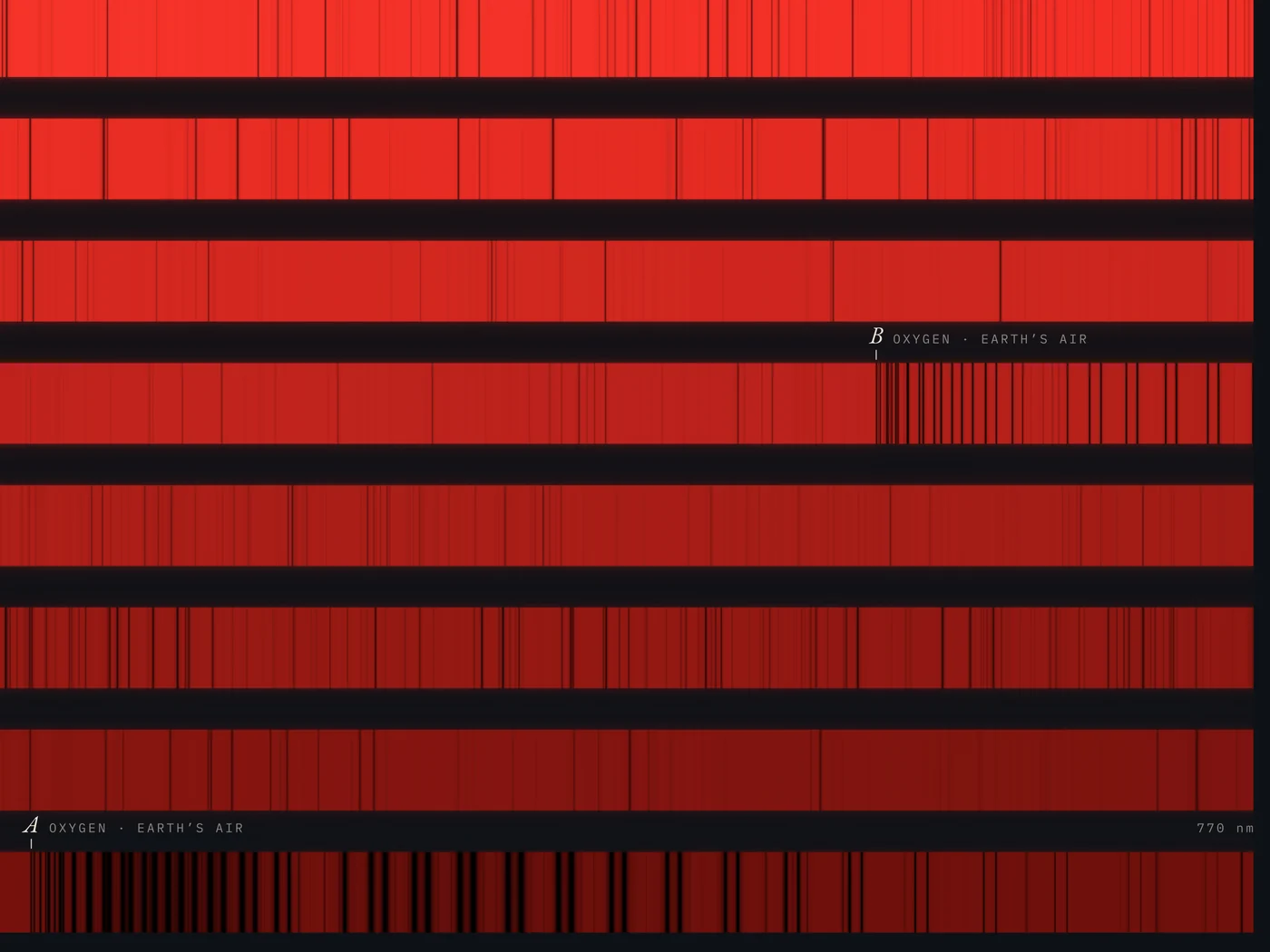
Pass sunlight through a slit and a prism and its rainbow is crossed by dark lines. In 1814 the Bavarian lens maker Joseph von Fraunhofer mapped 574 of them, lettering the strongest A to H, and later measured their wavelengths with gratings of fine parallel wires. The strips are real sunlight, read like a page from violet to deep red. In 1859 Kirchhoff and Bunsen showed that each element absorbs its own colours, so D is sodium. Lines in starlight tell us what any star we can see is made of.
The strips are sunlight itself, measured with the solar telescope on Kitt Peak, Arizona, and every dark line sits at its measured wavelength. Each wavelength is shown in the colour the eye sees it as, and the type is set from the same files that go to the printer.
Sunlight from the Kitt Peak solar atlas of Brault and Neckel, as distributed with ISPy (Institute for Solar Physics, MIT licence). Colours from the CIE 1931 standard observer (CIE, CC BY-SA 4.0).
Sizes and prices
| Size | Unframed | Framed | |
|---|---|---|---|
| Small30 × 42 cm | £50$85 | £140$185 | 297 × 420 mm |
| Medium42 × 59 cm | £95$145 | £225$295 | 420 × 594 mm |
| Large59 × 84 cm | £160$215 | £390$515 | 594 × 841 mm |
| Extra large84 × 119 cm | £285$385 | Unframed only | 841 × 1189 mm |
- Paper: Canson Baryta, 310 gsm, printed as a giclée by theprintspace.
- Printed in: London for the UK, Brooklyn for the US. Small unframed prints travel flat, larger ones rolled in a tube.
- Framed small: A3 frame, glazed with glass.
- Framed medium: A2 frame, glazed with 3 mm acrylic.
- Framed large: A1 frame, glazed with 3 mm acrylic.
- Extra large: unframed only. A0 is a standard frame size.
- Frames: solid wood, finished in black, white or oak veneer, made in Germany. Each comes ready to hang.
- Edition: open, with a certificate. File version v1.