The Canon
Demonstration I
Universal Gravitation
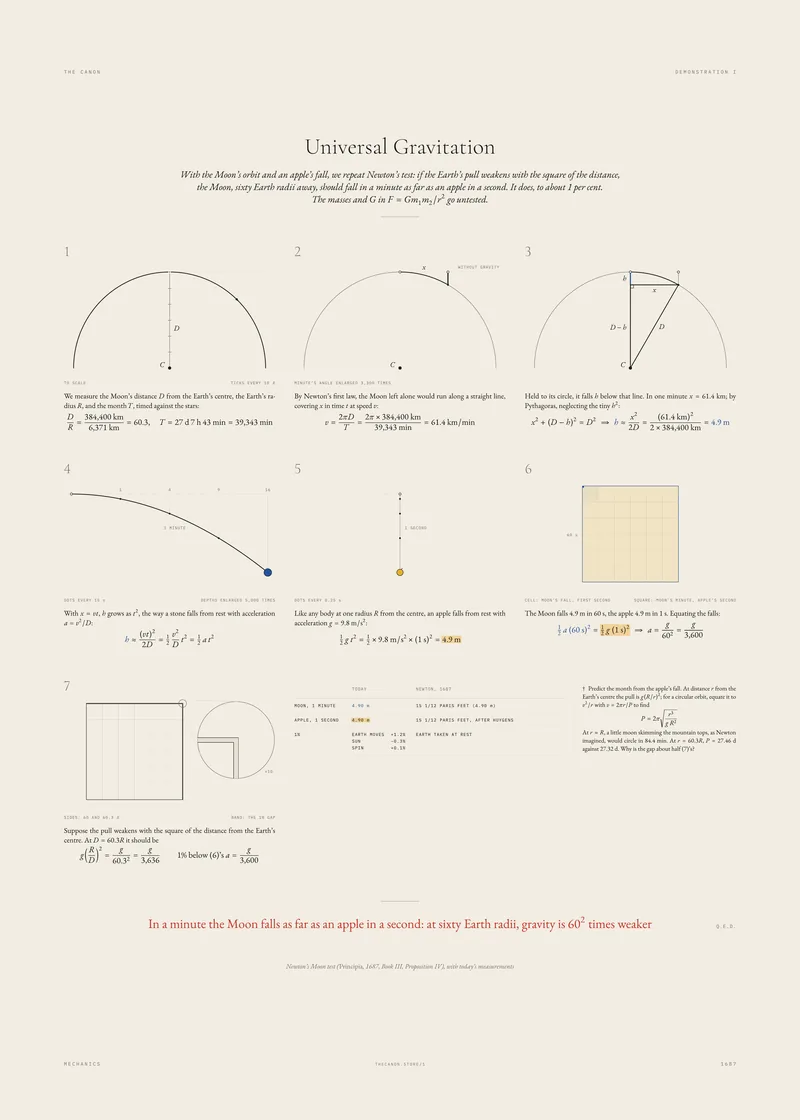
The Moon test Newton published in his Principia in 1687, worked out step by step.
A Demonstration is a plate’s companion print: the reasoning behind the discovery, worked out on a sheet of its own.
Paper ground, a warm cream, on Hahnemühle Photo Rag, 308 gsm cotton

The plate it accompanies
Plate I, Universal Gravitation: An orbit is a fall that never lands. See it
What it shows
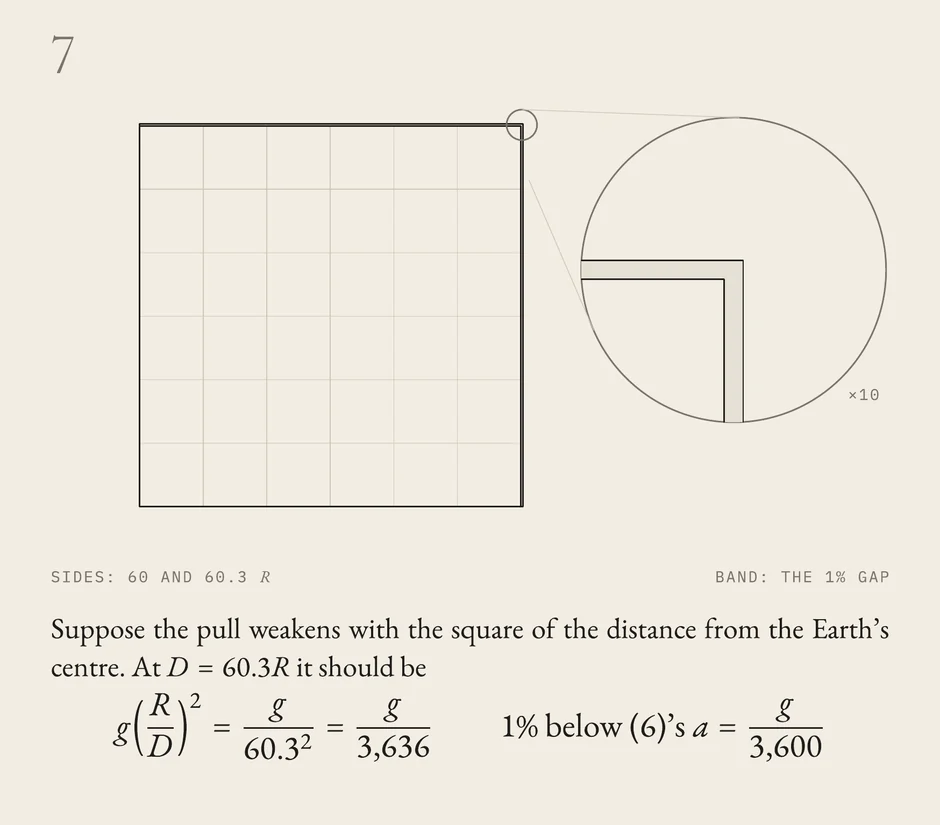
In his Principia of 1687, Newton set out to show that the force holding the Moon in its orbit is the same gravity that makes an apple fall. The Moon is about sixty times farther from the Earth’s centre than an apple on a tree. If gravity weakens with the square of the distance, the Moon should drop below its straight course in a minute as far as the apple falls in the first second after it starts falling.
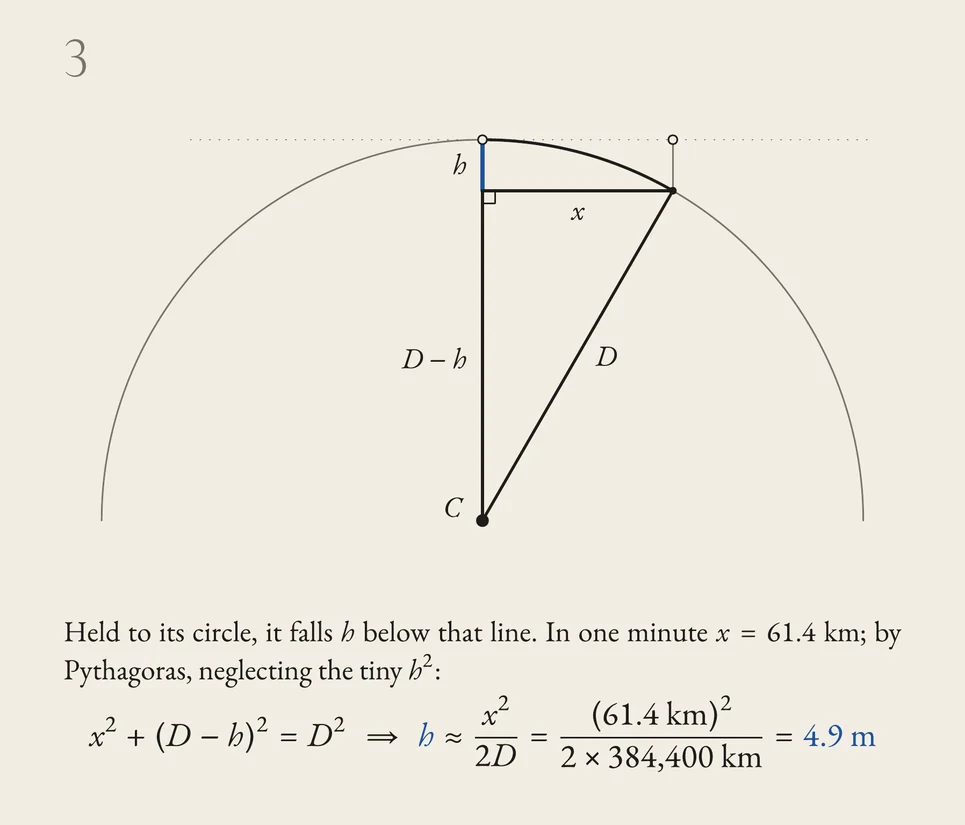
With today’s figures for the Moon’s distance and the length of the month, the Moon’s drop in a minute comes to 4.9 metres, the same distance the apple falls in one second. The two agree to about one per cent, and most of the difference comes from treating the Earth as fixed, as Newton did.
The sheet sets Newton’s own figures beside today’s. He found that the Moon drops 15 1/12 Paris feet in a minute, or 4.90 metres, and that a body near the ground falls the same distance in one second. The Paris foot was a common unit in the science of the day.
Close up, at about the size it prints at Medium

Hang them together
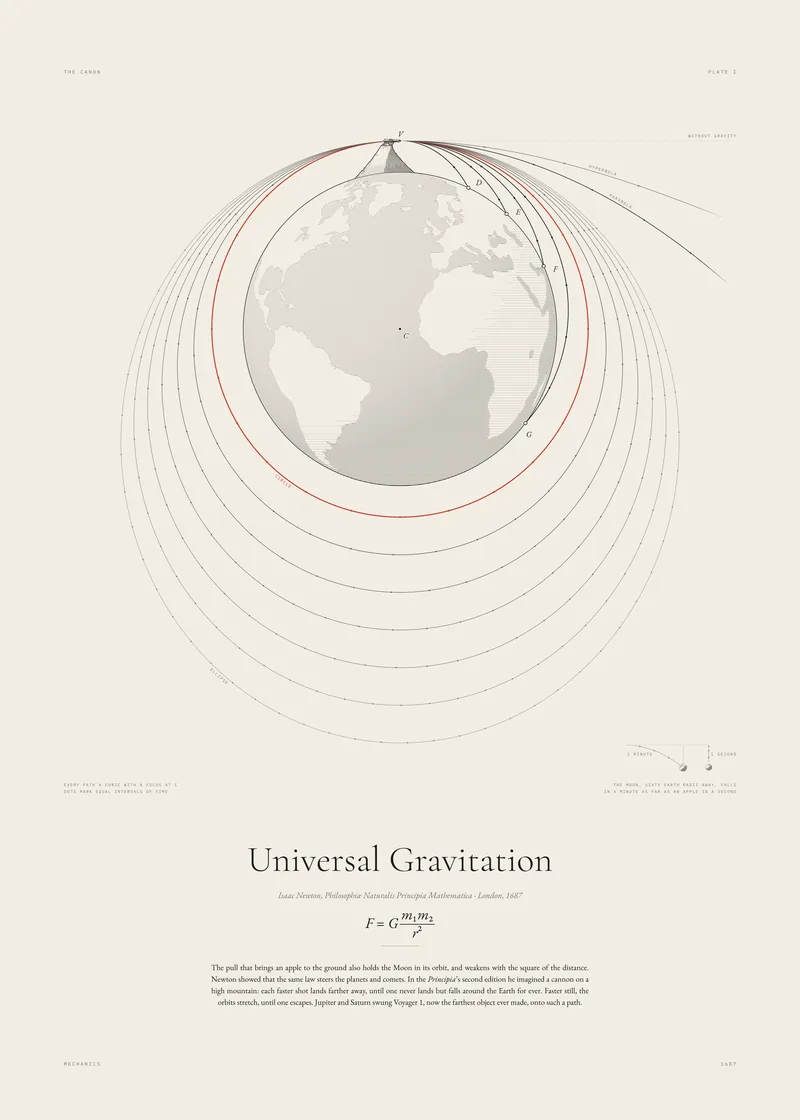
Demonstration I is the companion to Plate I, Universal Gravitation, which shows the law at work. Hung side by side in the same size and frame, the two cost 10% less bought together.
Plate I and Demonstration I, Medium, 42 × 59 cm each, in black frames.
The sheet
Newton’s Moon test (Principia, 1687, Book III, Proposition IV), with today’s measurements
- 1The Moon’s distance and its month, as measured
- 2Its speed along the orbit
- 3How far it falls in a minute
- 4Why the fall grows as the square of the time
- 5An apple’s fall in one second
- 6The two falls compared
- 7The inverse square, put to the test
- †And a question to take further: the month, predicted from the apple
Sizes and prices
| Size | Unframed | Framed | |
|---|---|---|---|
| Medium42 × 59 cm | £95$145 | £225$295 | 420 × 594 mm |
| Large59 × 84 cm | £160$215 | £390$515 | 594 × 841 mm |
| Extra large84 × 119 cm | £285$385 | Unframed only | 841 × 1189 mm |
- Paper: Hahnemühle Photo Rag, 308 gsm cotton, printed as a giclée by theprintspace.
- Printed in: London for the UK, Brooklyn for the US. Unframed prints travel rolled in a tube.
- Framed medium: A2 frame, glazed with 3 mm acrylic.
- Framed large: A1 frame, glazed with 3 mm acrylic.
- Extra large: unframed only. A0 is a standard frame size.
- Frames: solid wood, finished in black, white or oak veneer, made in Germany. Each comes ready to hang.
- Edition: open, with a certificate. File version v1.