The Canon
Plate I
Universal Gravitation
An orbit is a fall that never lands.
Paper ground, a warm cream, on Hahnemühle Photo Rag, 308 gsm cotton

Its companion print
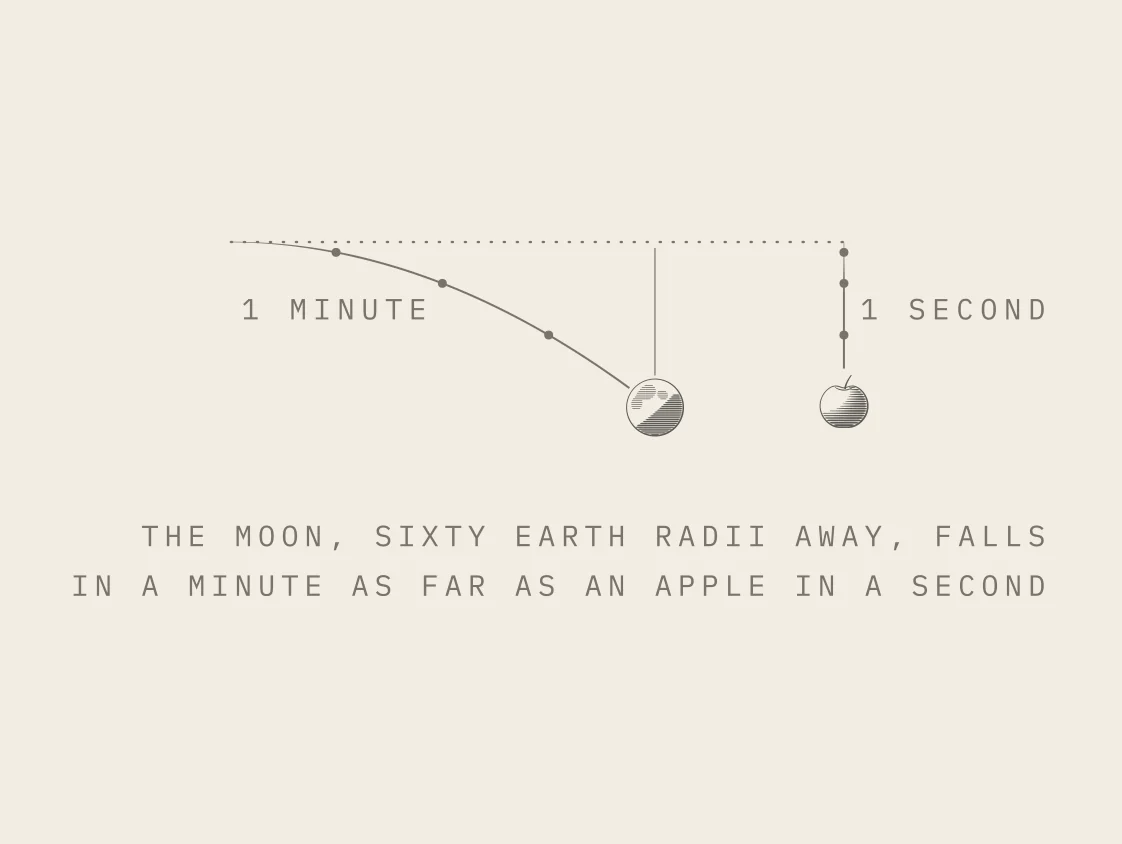
Demonstration I: The Moon test Newton published in his Principia in 1687, worked out step by step. See it
On the wall

Why it endures
Newton’s law explained why Kepler’s rules for the planets work, and why they hold only nearly: the planets pull on one another too. The same law accounted for the tides, the flattening of the spinning Earth, and the slow wobble of its axis.
Edmond Halley used it to predict that the comet of 1682 would return in 1758. It was sighted on Christmas Day 1758, and now bears his name. In 1846, Urbain Le Verrier traced the irregularities in Uranus’s motion to an unseen planet, and Johann Galle found Neptune within a degree of where Le Verrier said it would be.
But Mercury would not fit. Its orbit turns slightly too fast, and the excess went unexplained until general relativity in 1915.
The law is still at work. Since 2002, paired satellites, one trailing the other, have mapped the Earth’s gravity month by month. From its changes, scientists weigh the ice Greenland loses and the groundwater pumped from beneath northern India.
Hang them together
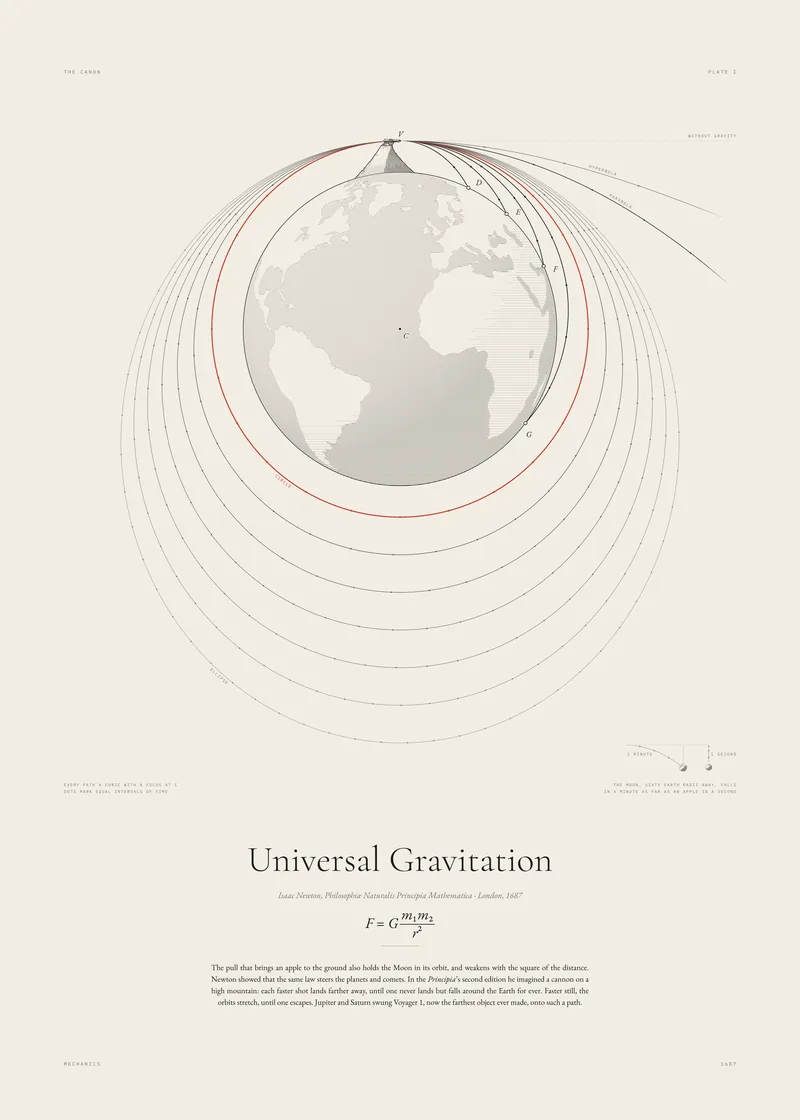
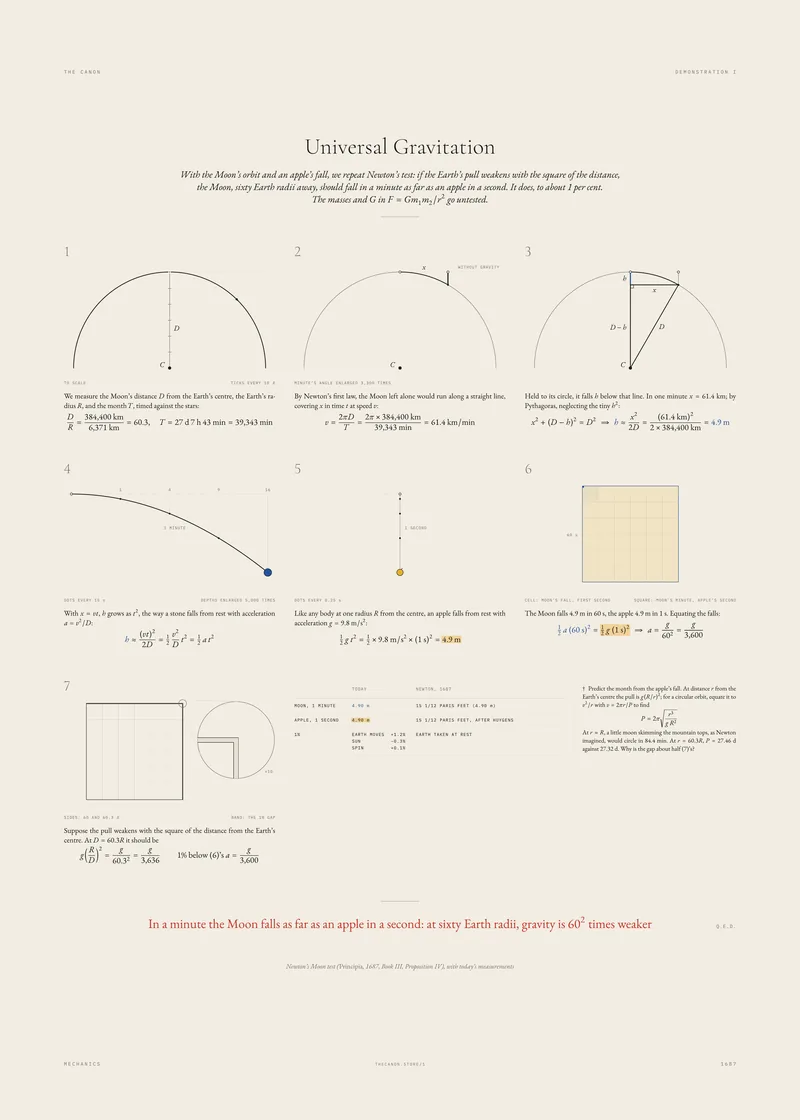
Plate I has a companion print, Demonstration I, which works out Newton’s Moon test step by step. Hung side by side in the same size and frame, the two cost 10% less bought together.
Plate I and Demonstration I, Medium, 42 × 59 cm each, in black frames.
The plate
Isaac Newton, Philosophiæ Naturalis Principia Mathematica · London, 1687
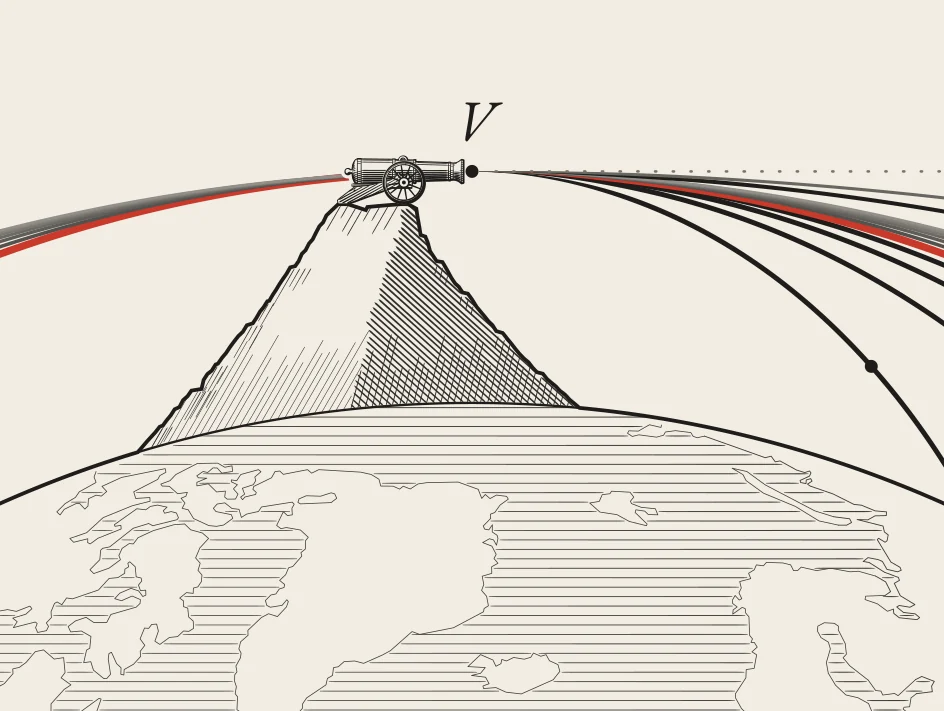
The pull that brings an apple to the ground also holds the Moon in its orbit, and weakens with the square of the distance. Newton showed that the same law steers the planets and comets. In the Principia’s second edition he imagined a cannon on a high mountain: each faster shot lands farther away, until one never lands but falls around the Earth for ever. Faster still, the orbits stretch, until one escapes. Jupiter and Saturn swung Voyager 1, now the farthest object ever made, onto such a path.
Every path, time dot and coastline on the plate comes from the mathematics or from real data. The gun, the mountain, the apple and the Moon’s seas are drawn, and the type is set from the same files that go to the printer.
Coastlines and lakes from Natural Earth’s public-domain map data (naturalearthdata.com).
Sizes and prices
| Size | Unframed | Framed | |
|---|---|---|---|
| Small30 × 42 cm | £50$85 | £140$185 | 297 × 420 mm |
| Medium42 × 59 cm | £95$145 | £225$295 | 420 × 594 mm |
| Large59 × 84 cm | £160$215 | £390$515 | 594 × 841 mm |
| Extra large84 × 119 cm | £285$385 | Unframed only | 841 × 1189 mm |
- Paper: Hahnemühle Photo Rag, 308 gsm cotton, printed as a giclée by theprintspace.
- Printed in: London for the UK, Brooklyn for the US. Small unframed prints travel flat, larger ones rolled in a tube.
- Framed small: A3 frame, glazed with glass.
- Framed medium: A2 frame, glazed with 3 mm acrylic.
- Framed large: A1 frame, glazed with 3 mm acrylic.
- Extra large: unframed only. A0 is a standard frame size.
- Frames: solid wood, finished in black, white or oak veneer, made in Germany. Each comes ready to hang.
- Edition: open, with a certificate. File version v1.